


Many pet owners ask, ‘Can dogs see color?’ or do they only see the world in black and white? In this guide, we explore the science behind canine vision.
Medically Reviewed by Dr. Sarah Mitchell, DVM Small Animal Veterinarian, 12 years clinical experience | Last Updated: May 2026
About the Reviewer: Dr. Sarah Mitchell, DVM, is a small animal veterinarian with over 12 years of clinical experience. She specializes in preventive care and canine nutrition, and regularly advises pet owners on understanding their dog’s sensory world.

You throw a bright red ball across the green lawn. Your dog bolts after it, then stops, nose down, sniffing in circles. Was the ball invisible to them? Not quite but you might be surprised by what they actually saw. The long-standing myth that dogs see only in black and white has been scientifically disproven. Dogs can see color, just a much narrower range than humans.
“One of the most common misconceptions I hear from pet owners is that their dog lives in a black-and-white world. Dogs actually see yellows, blues, and grays and understanding this can change how you care for your pet.” Dr. Sarah Mitchell, DVM
In this 2026 vet-backed guide, we explain exactly what colors dogs can see, the science behind dog color vision, and practical tips for toys, training, and daily life.
The Black-and-White Myth Debunked
For decades, the idea that dogs see only in black and white was widely accepted. The myth traces back to Will Judy, a dog writer who published this claim in his 1937 book Training the Dog. It spread into popular culture for nearly 50 years.
The turning point came in 1989. Ophthalmologist Jay Neitz and his colleagues at UC Santa Barbara conducted controlled experiments. They proved that dogs have working color-sensing cone cells and can distinguish certain wavelengths. Their findings, published in Visual Neuroscience, changed the scientific consensus for good.
According to AKC Expert Advice, dogs are not colorblind in the complete sense. They simply see a more limited range of color than most humans do.
How Dog Eyes Work The Science Behind Color Vision
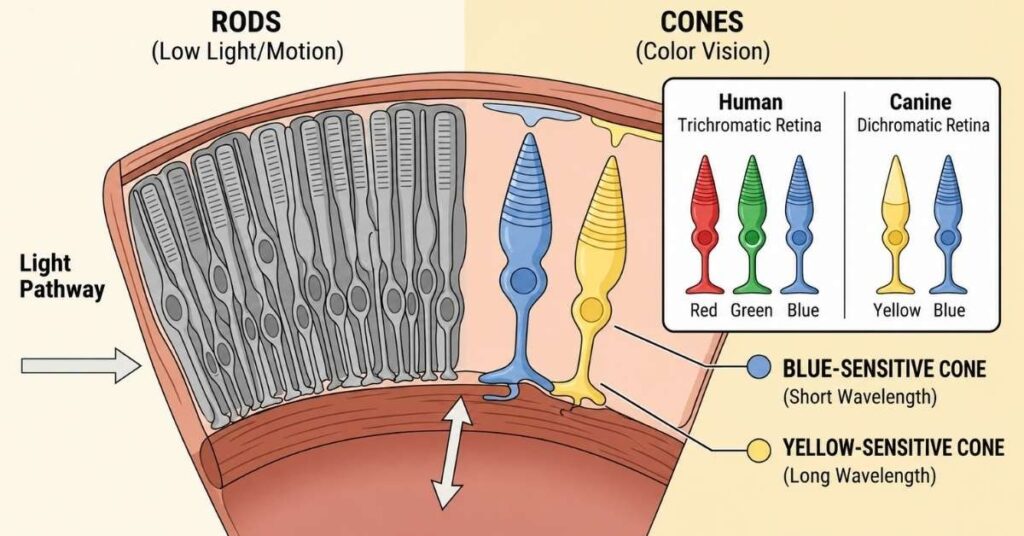
To understand how dogs see color, you first need to understand how eyes detect it.
The retina the light-sensitive layer at the back of the eye has two types of cells:
- Rods detect: light levels, motion, and shading. They work in dim light but cannot detect color.
- Cones detect: color. Different cone types respond to different wavelengths of light.
Humans have 3 cone types (trichromatic vision) detecting red, green, and blue. This lets us see roughly 1 million distinct colors.
Dogs have only 2 cone types (dichromatic vision) detecting yellow and blue. The cone for red and green is absent in dogs.
This is the same as a human with red-green color blindness affecting roughly 8% of men worldwide.
According to VCA Animal Hospitals, dogs can perceive different colors, but may not see the true color of an object the way we do.
What About Night Vision?
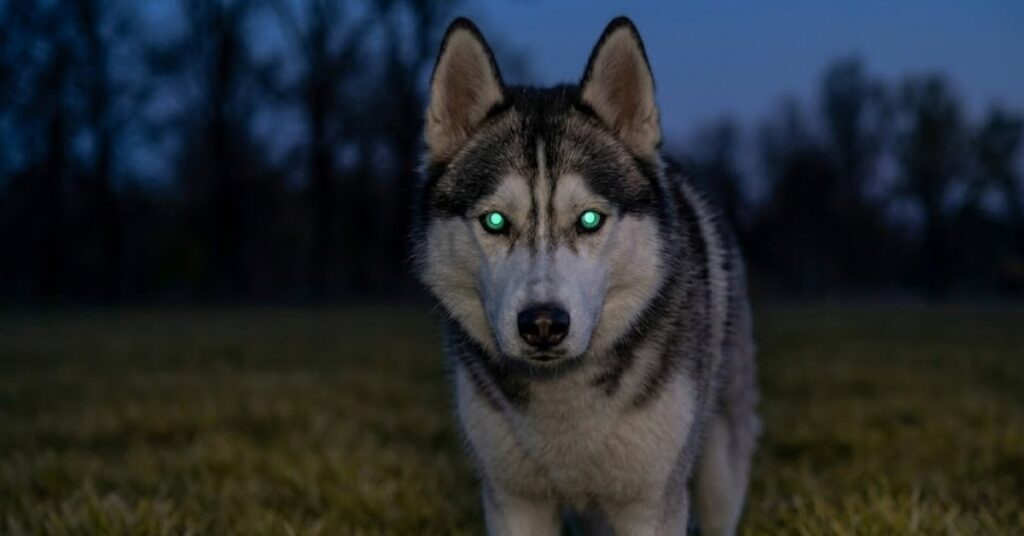
While dogs have fewer cones than humans, they have significantly more rods. This gives them major advantages:
- Night vision: Dogs see clearly in up to 6 times less light than humans
- Motion detection: Dogs can spot a moving object at distances humans would miss completely
- Tapetum lucidum: Dogs have a reflective membrane behind the retina. It bounces light back through the photoreceptors, giving the eye a second chance to capture detail. This also causes the “eye glow” effect in photos.
What Colors Can Dogs See Best?
Based on canine cone cell studies and behavioral testing, here is what the color spectrum looks like through a dog’s eyes:
| Color (Human View) | What Dogs See |
| Red | Dark brownish-gray or near black |
| Orange | Dull yellow or muddy brown |
| Yellow | Yellow — sees clearly |
| Green | Pale yellow or grayish |
| Blue | Blue — sees clearly |
| Blue-Green | Blue |
| Violet / Purple | Blue |
| White | White |
| Gray | Gray |
| Black | Black |
The two colors dogs see best are yellow and blue.
This is why:
- Dogs prefer yellow tennis balls over red ones
- Dog agility equipment is painted in yellow and blue
- A red toy thrown on green grass effectively disappears for your dog both look like muddy brown to them
Toy shoppers take note: The most popular dog toy colors in pet shops are red and orange, the hardest colors for dogs to distinguish. Choose blue or yellow toys for best visibility.
Can Dogs See Color as Well as Humans? Full Comparison
| Feature | Dogs | Humans |
| Cone types | 2 (dichromatic) | 3 (trichromatic) |
| Colors visible | Yellow, blue, gray | Full spectrum (~1M colors) |
| Visual acuity | ~20/75 vision | ~20/20 vision |
| Night vision | Excellent (6x better) | Poor |
| Motion detection | Superior | Good |
| Field of vision | ~250 degrees | ~190 degrees |
| UV light sensitivity | Can detect UV | Cannot detect UV |
| Color brightness | Muted, less vivid | Vibrant |
How Sharp Is Dog Vision?
Most dogs have approximately 20/75 vision. A dog must stand 20 feet away to see what a human sees clearly from 75 feet. So your dog’s world is a little blurrier than yours.
However, dogs compensate powerfully with smell. According to Scientific American, a dog’s sense of smell is 10,000 to 100,000 times stronger than a human’s. Moreover, a study in the Journal of Neuroscience found a direct brain connection between a dog’s smell center and vision center, a link not found in any other species. Dogs may use scent to literally guide what they look at.
UV Light — A Hidden Superpower
Dogs can also detect ultraviolet (UV) light that is invisible to humans. Research from Zoetis PetCare shows dogs allow over 61% of UV light to the retina, compared to near zero for humans. Because of this, dogs can:
- See better at night and in low light
- Spot camouflaged prey more easily
- Detect urine markings invisible to human eyes which is why dogs sniff spots that look blank to us
Does Dog Color Vision Differ by Breed?
Yes — although the color palette is the same for all dogs, other aspects of vision vary based on skull shape and eye placement.
| Breed Type | Eye Position | Effect on Vision |
| Long-nosed breeds (Greyhound, Borzoi) | Set wide apart | Wider peripheral vision (270°+), smaller depth field |
| Flat-faced breeds (Pug, Bulldog, Pekingese) | Forward-facing | Better depth perception, larger rear blind spot |
| Average breeds (Labrador, Beagle) | Moderate | Balanced ~250° field of view |
According to Chewy’s veterinary team, facial conformation is the biggest factor affecting vision sharpness between individual dogs, not breed groups alone.
Practical Tips Using Dog Color Vision Every Day

1. Choosing the Right Toys
Always choose blue or yellow toys when possible. Red, orange, and pink toys on green grass are hard for dogs to spot because red and green look alike to them.
Best toy colors for dogs: Blue, yellow, white Avoid for outdoor play: Red, orange, green
2. Smarter Dog Training
Use blue or yellow markers and targets during training. Color contrast helps your dog recognize visual cues faster. Furthermore, traditional agility equipment uses yellow and blue specifically because of how dogs see color.
3. Safer Home Navigation
If your dog hesitates on stairs or ramps, place a yellow or blue contrast strip at each step edge. Because dogs have lower visual acuity, strong color contrast helps them navigate safely.
4. Better Fetch at the Dog Park
Switch from a red or orange ball to a yellow or blue one. The difference in how quickly your dog finds it will often be immediate and obvious.
Signs of Vision Problems in Dogs What to Watch For
While limited color range is completely normal for dogs, other vision problems do occur. Watch for these warning signs:
Early signs:
- Bumping into furniture, especially in dim light
- Hesitation going up or down stairs
- Startling easily when approached from the side
- Difficulty finding food or toys in familiar areas
More serious signs:
- Cloudy or bluish appearance in the eye (possible cataracts)
- Red, inflamed, or weeping eyes
- One eye appears larger than the other
- Visible third eyelid at the inner corner of the eye
When to see a vet: If you notice any of the above signs, schedule an eye exam promptly. Conditions like cataracts, progressive retinal atrophy (PRA), and glaucoma are far more treatable when caught early.
Frequently Asked Questions (FAQs)
1. Can dogs see color or are they completely colorblind? Dogs can see color; they are not completely colorblind. They have dichromatic vision with 2 cone types, compared to 3 in humans. Dogs see yellow and blue clearly, while red and green appear as muddy browns and grays.
2. What is the best color for a dog toy? Blue and yellow are the best colors for dog toys. These are the two colors dogs see most clearly. Red, orange, and pink toys are the hardest to see especially on green grass despite being the most commonly sold colors in pet shops.
3. Can dogs see in the dark? Yes, much better than humans. Dogs have more rod cells, larger pupils, and a reflective membrane called the tapetum lucidum. Together, these allow dogs to see clearly in up to 6 times less light than humans need.
4. Can dogs see TV or screens? Yes, dogs can see modern TV screens. However, dogs detect flicker faster than humans do. So, older 60Hz TVs looked like flickering strobe lights to them. Modern screens running at 120Hz or higher look smooth and clear to dogs.
5. Do dogs see the same as color-blind humans? Yes, almost exactly. A dog’s vision is most similar to a human with red-green color blindness. Both see yellows and blues clearly, but cannot tell red from green both appear as similar brownish tones.
6. Can dogs see UV light? Yes. Dogs allow over 61% of UV light to reach their retinas, compared to near zero in humans. This helps them see better at night and detect urine markings invisible to human eyes.
7. Does color vision differ by dog breed? All dogs share the same two-cone color system, so the color palette is the same. However, the field of vision and sharpness vary by skull shape. Long-nosed breeds have wider peripheral vision, while flat-faced breeds have better forward depth perception.
8. Can puppies see color? Puppies are born with closed eyes and begin opening them at 10 to 14 days old. Their vision, including color perception, develops gradually. By 8 weeks, most puppies have functional dichromatic color vision similar to adult dogs.
9. How can I tell if my dog has a vision problem? Key signs include bumping into objects, hesitation on stairs, cloudy eyes, startling easily, and difficulty finding food or toys. If you notice any of these signs, consult your veterinarian promptly for an eye examination.
Conclusion
Can dogs see color? Absolutely yes. The black-and-white myth was debunked by science in 1989 and has been confirmed many times since. Dogs see the world in a real palette of yellows, blues, and grays through their two-cone dichromatic vision similar to a human with red-green color blindness.
What dogs lack in color range, they more than make up for in night vision, motion detection, UV sensitivity, and an extraordinary sense of smell that may actually guide what they look at.
So next time you shop for a dog toy, skip the red ball and grab a yellow or blue one. Your dog’s eyes and their wagging tail will thank you.
Explore more in our dog health and nutrition series:
- Can Dogs Eat Chocolate? Toxic Truth & Emergency Guide
- Can Dogs Eat Grapes? The Toxic Truth Every Owner Must Know
- Can Dogs Eat Bananas? Benefits, Risks & Serving Guide
- Can Dogs Eat Blueberries? Benefits & Complete Guide
- Why Is My Dog Coughing and Gagging? 7 Causes & What to Do
Did this guide help you see the world through your dog’s eyes? Share it with a fellow dog owner and drop your questions in the comments below!

Farhan Imran is the founder and lead editor of PetExpertly. With a background in managing pet-focused digital platforms like PurePawsLife, he is dedicated to researching and sharing the most reliable pet care advice. His goal is to help pet owners make informed decisions through well-researched guides