

What happens if a dog eats gum? If your dog just swallowed a piece of chewing gum, this could be a genuine medical emergency. Most chewing gum brands contain xylitol, an artificial sweetener that is completely harmless to humans but can be rapidly fatal to dogs. In this complete 2026 emergency guide, we cover exactly what happens inside your dog’s body, which gum brands are most dangerous, and the critical steps you must take in the next 30 minutes.
Medically Reviewed by Dr. Sarah Mitchell, DVM | Last Updated: May 2026
Disclaimer: This article is for informational purposes only and does not replace professional veterinary advice. If your dog is in pain or distress, contact your nearest vet clinic immediately.
What Happens If a Dog Eats Gum? The Science Explained
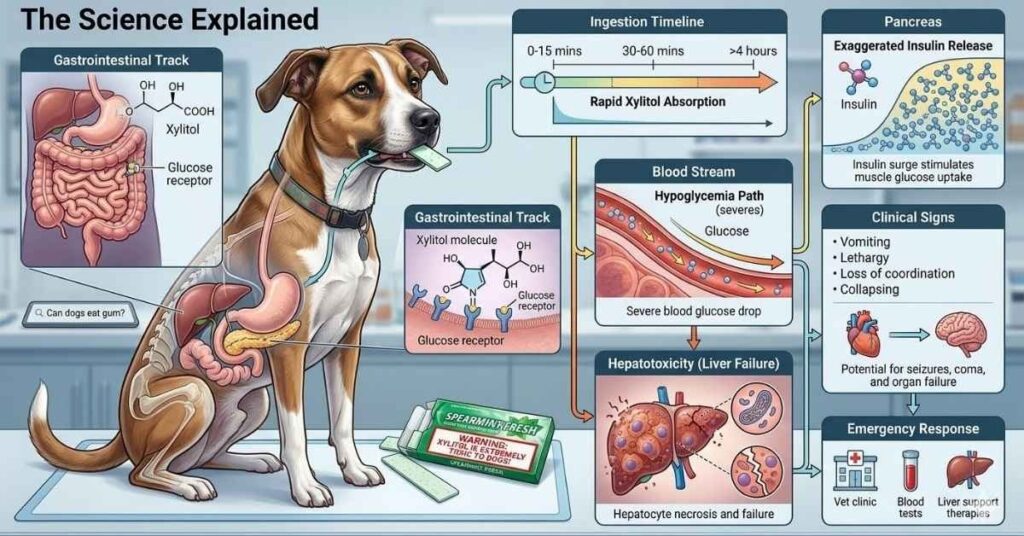
To understand why gum is so dangerous, you need to understand what xylitol does inside a dog’s body.
In humans, xylitol does not trigger an insulin response. In dogs, xylitol is rapidly absorbed into the bloodstream and causes a massive, sudden release of insulin from the pancreas. This causes blood sugar levels to crash dangerously low, a condition called hypoglycemia.
According to the American Kennel Club, even a tiny amount of xylitol as little as 0.1 grams per kilogram of body weight can cause life-threatening hypogly cemia in dogs. A single piece of xylitol-sweetened gum contains between 0.2 and 1.0 grams of xylitol. For a small 5kg dog, just 2 pieces of gum could be fatal.
Higher doses of xylitol above 0.5g per kg of body weight can cause acute liver failure within 24 to 72 hours of ingestion, even if the dog initially appears to recover.
Which Gum Brands Contain Xylitol?
Not all gum contains xylitol, but many popular brands do. Here is the complete comparison:
| Brand | Contains Xylitol? | Risk Level |
| Trident | Yes | 🔴 Extremely Dangerous |
| Orbit | Yes | 🔴 Extremely Dangerous |
| Ice Breakers Ice Cubes | Yes | 🔴 Extremely Dangerous |
| Stride | Yes | 🔴 Extremely Dangerous |
| Pur Gum | Yes | 🔴 Extremely Dangerous |
| Extra (some varieties) | Yes | 🔴 Dangerous |
| Juicy Fruit | No | 🟡 Low (blockage risk only) |
| Hubba Bubba | No | 🟡 Low (blockage risk only) |
| Bazooka | No | 🟡 Low (blockage risk only) |
Even gum without xylitol is unsafe for dogs. Sugar, artificial flavoring, and gum base can all cause digestive upset and intestinal blockages.
7 Emergency Signs to Watch For
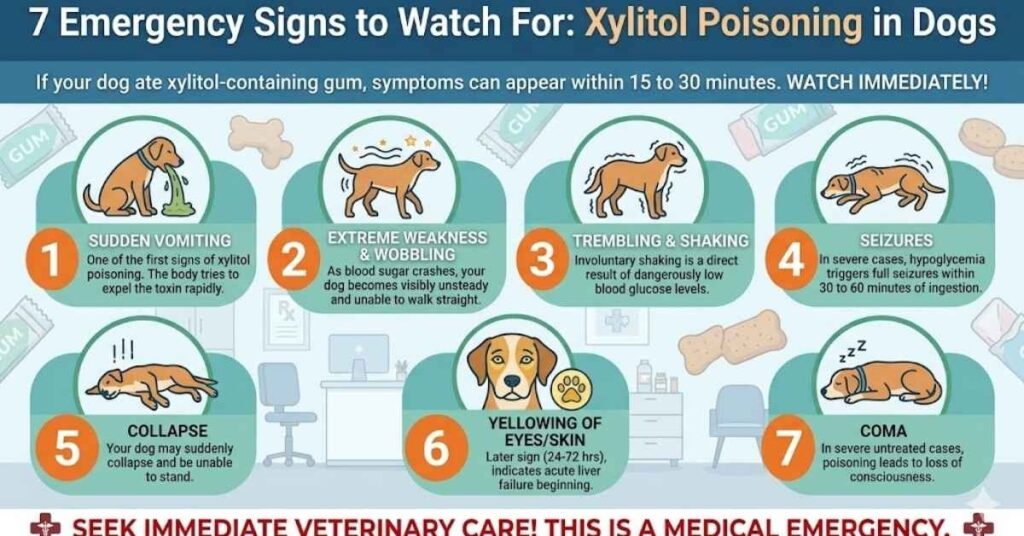
If your dog ate xylitol-containing gum, symptoms can appear within just 15 to 30 minutes. Watch for these warning signs immediately:
Sign 1 Sudden Vomiting One of the first signs of xylitol poisoning. The body tries to expel the toxin rapidly.
2:Extreme Weakness and Wobbling As blood sugar crashes, your dog becomes visibly unsteady and unable to walk straight.
3:Trembling and Shaking Involuntary shaking is a direct result of dangerously low blood glucose levels.
4:Seizures In severe cases, hypogly cemia triggers full seizures within 30 to 60 minutes of ingestion.
5:Collapse Your dog may suddenly collapse and be unable to stand.
6:Yellowing of Eyes or Skin This sign appears later within 24 to 72 hours and indicates acute liver failure beginning.
Sign 7 Coma In the most severe untreated cases, xylitol poisoning leads to loss of consciousness.
What to Do If a Dog Eats Gum Emergency Steps
Time is critical. Do not wait for symptoms before acting. Follow these steps immediately:
Step 1: Stay Calm and Act Fast. Panic wastes precious time. Take a deep breath and move quickly.
Step 2 Check the Gum Wrapper Find the packaging and check the ingredient list for xylitol, birch sugar, birch bark extract, or sugar alcohol. If any appear, treat it as an emergency.
Step 3 Note How Much Was Eaten Count how many pieces were consumed and note your dog’s approximate weight your vet needs this to calculate the toxic dose.
Step 4 Call Your Vet or Emergency Hotline Do not drive to the vet before calling they may instruct you to induce vomiting at home first.
🚨 ASPCA Animal Poison Control: (888) 426-4435 🚨 Pet Poison Helpline: (855) 764-7661
Step 5 Do NOT Induce Vomiting Without Vet Instruction Never attempt to make your dog vomit unless specifically instructed. Incorrect induction causes additional harm.
Step 6 Rush to Emergency Vet If symptoms have already appeared weakness, vomiting, trembling skip calling and go directly to your nearest emergency vet clinic.
What Will the Vet Do?
When you arrive at the vet, they will take several immediate steps:
Induced Vomiting: If ingestion was recent (within 1 to 2 hours) and no symptoms exist yet, the vet will safely induce vomiting.
IV Dextrose Drip: To counteract hypoglycemia, intravenous glucose is administered to stabilize blood sugar rapidly.
Liver Function Tests: According to Pet MD, blood tests check liver enzyme levels immediately to detect whether liver damage has begun.
Hospitalization: Most cases require 24 to 48 hours of monitoring, IV fluids, and liver support medication.
Liver Support Medication: If liver damage is detected, medications like SAMe and milk thistle extract may be administered.
How Much Xylitol Is Toxic? Dose Calculator
| Dog Weight | Hypoglycemia Risk | Liver Failure Risk |
| 2 kg | 0.2g xylitol | 1.0g xylitol |
| 5 kg | 0.5g xylitol | 2.5g xylitol |
| 10 kg | 1.0g xylitol | 5.0g xylitol |
| 25 kg | 2.5g xylitol | 12.5g xylitol |
One piece of Trident gum contains approximately 0.17g of xylitol. Just 3 pieces can cause hypoglycemia in a 5kg dog.
Other Products That Contain Xylitol
Many dog owners are shocked to learn xylitol hides in everyday products beyond gum:
Peanut Butter: Some brands use xylitol as a sweetener. Always check before giving peanut butter to your dog.
Toothpaste: Human toothpaste almost always contains xylitol. Never use it on dogs.
Mouthwash: Contains high concentrations of xylitol.
Sugar-Free Candy: Any sugar-free candy may contain xylitol.
Chewable Vitamins: Certain children’s vitamins use xylitol as a sweetener.
Baked Goods: Sugar-free baked goods often use xylitol as a sugar replacement.
For a complete guide on toxic foods, read Can Dogs Eat Chocolate? and Can Dogs Eat Grapes?
How to Prevent Your Dog From Eating Gum
These simple steps protect your dog every day:
Keep Gum in Closed Drawers: Never leave gum on tables or in open bags accessible to your dog.
Check Handbags and Backpacks: Dogs frequently raid bags looking for snacks. Always keep bags zipped and out of reach.
Educate Family Members: Make sure everyone, especially children knows gum is toxic to dogs.
Use Dog-Safe Dental Chews: For safe treat ideas, check out Can Dogs Eat Apples? and Can Dogs Eat Watermelon?
Frequently Asked Questions
1. What happens if a dog eats gum without xylitol? If the gum does not contain xylitol, it is far less dangerous. The gum base can still cause intestinal blockages, especially in small dogs. Monitor your dog for vomiting, constipation, or abdominal pain and contact your vet if symptoms appear.
2. My dog ate one piece of gum. Should I worry? It depends entirely on the brand. Check the wrapper for xylitol immediately. If xylitol is present, contact your vet right away even one piece can be dangerous for a small dog. Use the dose calculator above to assess the risk based on your dog’s weight. If no xylitol is listed, monitor your dog closely for 24 hours for signs of blockage.
3. How quickly does xylitol affect dogs? Xylitol is absorbed extremely rapidly. Hypoglycemia symptoms appear within 15 to 30 minutes. Liver failure symptoms typically develop within 24 to 72 hours.
4. Can a dog survive xylitol poisoning? Yes but only with immediate veterinary treatment. Dogs that receive prompt medical care within the first hour have a much higher survival rate. Delayed treatment significantly worsens the prognosis.
5. What happens if a dog eats gum and seems fine? Do not assume your dog is safe just because they appear normal. Xylitol symptoms can be delayed. Liver failure can develop silently over 24 to 72 hours. Always contact your vet even if your dog seems fine after eating xylitol gum.
6. Is sugar-free gum more dangerous than regular gum for dogs? Yes, significantly more dangerous. Sugar-free gum almost always contains xylitol. Regular gum uses sugar instead but neither is safe for dogs to consume.
7. What happens if a dog eats gum repeatedly over time? Even small repeated exposures to xylitol can accumulate and cause chronic liver damage. Repeated gum ingestion also increases the risk of intestinal blockages from the gum base.
Conclusion:
Xylitol-containing gum is one of the most dangerous household items your dog can consume. Within minutes it triggers a catastrophic blood sugar crash. Within hours it can begin destroying the liver. Without emergency treatment, it can be fatal.
The most important thing to remember: if your dog eats gum, check the wrapper immediately for xylitol and call your vet or the ASPCA Poison Control Hotline at (888) 426-4435 right away. Do not wait for symptoms.
For more expert dog safety guides, explore:
- Can Dogs Eat Chocolate?
- Can Dogs Eat Grapes? TOXIC
- Can Dogs Have Palm Oil?
- Can a Dog Break Its Tail?
Did this emergency guide help you? Share it with every dog owner you know it could save a life!

Farhan Imran is the founder and lead editor of PetExpertly. With a background in managing pet-focused digital platforms like PurePawsLife, he is dedicated to researching and sharing the most reliable pet care advice. His goal is to help pet owners make informed decisions through well-researched guides